The government had reportedly asked Nepal Telecom to divide the billing-system procurement into separate contracts rather than awarding the entire system under a single tender.
Nepal Telecom has invited international bids for the supply, delivery, installation, and commissioning of a Convergent Real-Time Billing (CRTB) and Customer Support (CS) system on a virtualized platform.
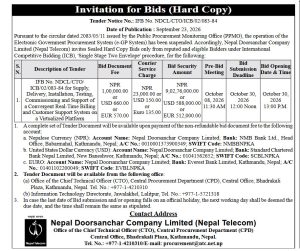
The state-owned telecom operator published a notice today calling for bids for the “Supply, Delivery, Installation and Commissioning of Convergent Real Time Billing (CRTB) and Customer Support (CS) System on Virtualized Platform.”
The tender is being conducted through an International Competitive Bidding (ICB) process using a single-stage, two-envelope procedure.
Hard-Copy Bids Required This Time
Unlike the usual process, Nepal Telecom is accepting sealed hard-copy bids for this tender.
The move comes after the government’s Electronic Government Procurement (e-GP) system was suspended following a cyber incident. According to a circular issued by the Public Procurement Monitoring Office (PPMO) on August 27, 2026 (B.S. 2083/05/11), the e-GP system remains suspended, requiring procurement processes to be handled through alternative arrangements.
Nepal Telecom has therefore requested physical, sealed bids for the current procurement.
Tender Fees and Bid Security
According to the published notice, bidders will need to pay NPR 100,000 for the tender documents. The equivalent fee is listed as USD 660 or EUR 570.
An additional NPR 23,000 is required for courier services, equivalent to USD 150 or EUR 135.
The required bid security has been set at NPR 902.76 million, equivalent to approximately USD 5.88 million or EUR 5.12 million.
Nepal Telecom spokesperson Dr. Kamal Lamichhane told TechnoKhabar that the exact project value could not be disclosed at this stage. However, he said the bid security amount is roughly 2% to 3% of the total amount.
Details of the Tender Documents
Detailed information about the procurement was not immediately available publicly.
When asked where potential bidders could access the preliminary tender documents, Lamichhane said the documents had not yet been posted elsewhere. He added that the relevant department would be asked to prepare and make the necessary information available.
The tender also includes eligibility requirements for international organizations participating in the procurement.
Asked whether the tender requires participating organizations to appear on a Gartner list or receive a Gartner recommendation, Lamichhane said Nepal Telecom had followed the criteria prescribed by the Public Procurement Monitoring Office.
He added that, because the project concerns the country’s telecommunications infrastructure, the requirements were prepared while considering previous experience and lessons learned from similar procurements.
Tender Submission Deadline
Interested bidders must submit their sealed bids by 12:00 noon on October 30, 2026, corresponding to Ashwin 14, 2083 B.S.
The submitted bids will be opened at 1:00 PM on the same day.
The new CRTB and customer support system is expected to support Nepal Telecom’s billing and customer-service operations through a virtualized platform. Further technical and commercial details will become clearer once the full tender documents are made available.
Nepal Telecom had previously cancelled its tender for a new billing system after the procurement process had reached the final stages.
After initiating the tender process and moving close to the final decision, the company cancelled the entire procurement process through a public notice issued on January 18, 2026 (Magh 4, 2082 B.S.), roughly nine months after the tender was launched.
The procurement had faced controversy from the beginning.
During the technical evaluation, Huawei Technologies Co., Ltd. of China was found to be the only qualified bidder. The tender attracted further scrutiny after Nepal Telecom announced that Huawei’s financial proposal would be opened following the technical evaluation.
The tender had originally been announced on March 18, 2025. Only two companies—Chinese technology company Huawei and HL Cloud—submitted proposals. Following the evaluation, Nepal Telecom deemed HL Cloud ineligible while Huawei qualified for the next stage.
This was not the first time Nepal Telecom had cancelled a billing-system tender because of limited competition. In an earlier procurement, only U.S.-based CSG International had submitted a bid, leading the company to cancel that tender as well.
The previous tender, issued for a Convergent Real-Time Billing and Customer Support System, was reportedly valued at around NPR 5 billion.
Government Had Asked Telecom to Split the Procurement
The government had reportedly asked Nepal Telecom to divide the billing-system procurement into separate contracts rather than awarding the entire system under a single tender.
Nepal Telecom, however, has again sought bids for a complete system, following an approach similar to the previous procurement.
The earlier tender also included a requirement related to Gartner’s market listings. Under the previous tender documents, bidders were required to have been listed at least twice since 2021 in Gartner’s market guides covering Communications Service Provider (CSP) Revenue Management and Monetization (RM&M) and CSP Customer Management and Experience (CM&X) solutions.
The Gartner market guides referenced companies including DigitalRoute, Netcracker, Oracle, Matrix Software, Singleview, Comviva, Ericsson, MIND, PortaOne, Zeuss, Huawei, Comarch, Amdocs, CSG, Aria Systems, Tecnotree, Nokia, Lifecycle, SAP, and AsiaInfo, among others.
The previous procurement was ultimately cancelled before Nepal Telecom proceeded with the latest tender for its billing and customer-support system.
Dollar Exchange Rate Also Raises Questions
The U.S. dollar exchange rate used for the latest billing-system tender has also drawn attention.
According to a Nepal Telecom official, the dollar rate would be based on the exchange rate applicable either on the day the tender is opened or on the day the contract is signed. Based on that explanation, the current tender appears to have been prepared with an exchange rate close to the current rate of around NPR 153.08 per U.S. dollar.
However, a comparison of the bid-security amount stated in Nepalese rupees and U.S. dollars suggests that the tender uses an exchange rate of approximately NPR 153.53 per dollar.
The previous tender documents used a significantly lower exchange rate of NPR 117 per U.S. dollar, based on the rate specified at the time. The difference in the exchange-rate basis was also relevant because only one company ultimately qualified to participate in that procurement.
Delayed Billing System Procurement
Nepal Telecom’s billing-system procurement has remained a contentious issue, and the company has yet to replace a system that it considers increasingly necessary for its operations.
The delay has reportedly resulted in significant recurring costs for the company, while customers have continued to experience technical issues with billing services from time to time.
With the new billing system still pending, Nepal Telecom has continued maintaining its existing, decades-old billing infrastructure. The company has reportedly been paying millions of rupees annually to Chinese technology company AsiaInfo for annual maintenance services under an Annual Maintenance Contract (AMC).
The maintenance arrangement has also faced scrutiny and controversy in the past.
The latest tender is therefore significant not only because of its size, but also because Nepal Telecom has been attempting to replace its existing billing infrastructure after several previous procurement efforts failed to reach completion.